
Why Flow Benches Lie When the Combo Is Wrong
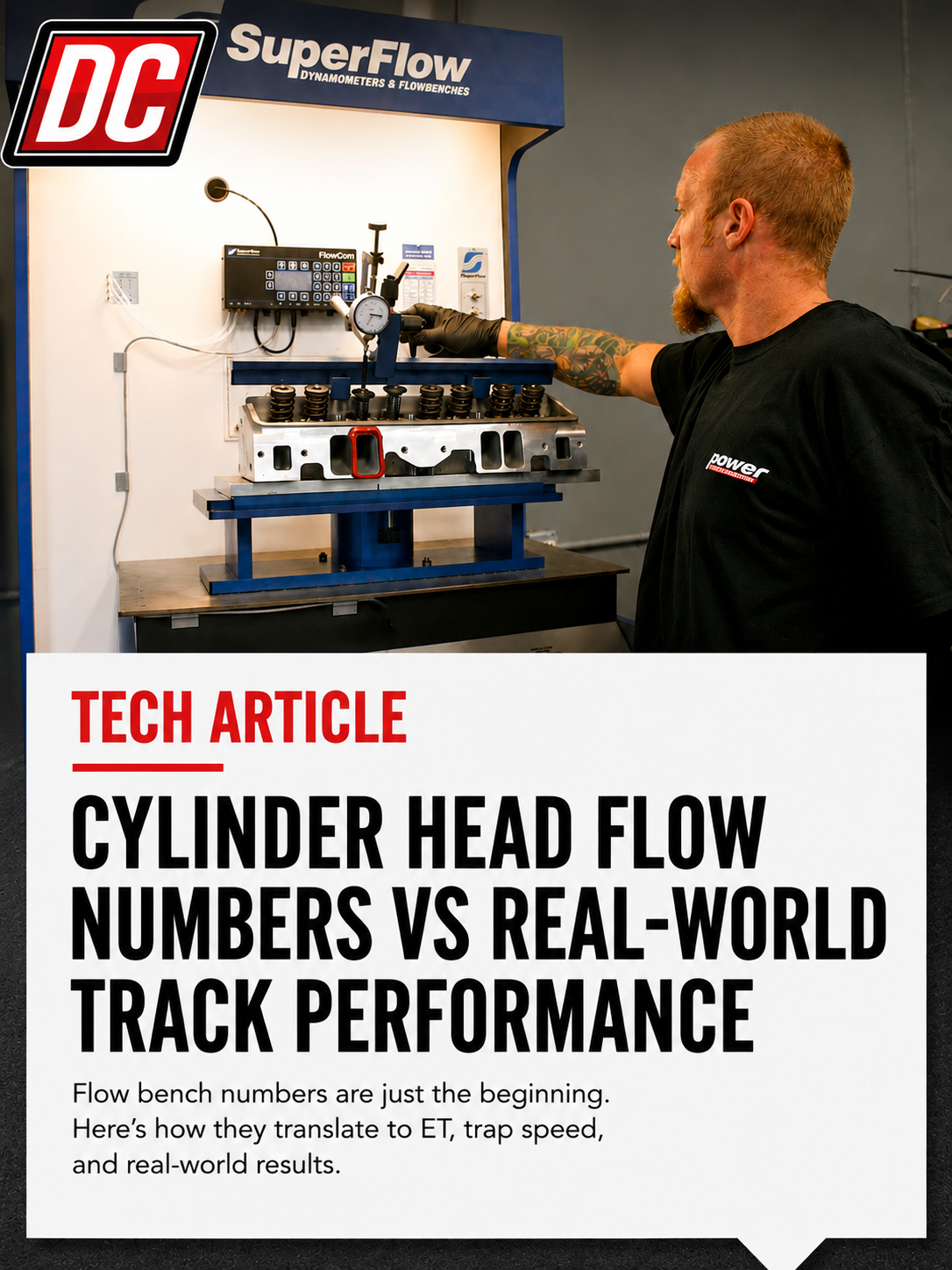
Cylinder head flow numbers are some of the most quoted—and most misunderstood—data points in drag racing. Racers will argue over cubic feet per minute (CFM) like it is a direct measure of horsepower, ET, and win lights.

Yet every season, cars with “worse” heads outrun cars with better flow sheets.
The disconnect is not that flow benches are useless. The problem is that flow numbers only tell a small part of the story, and when applied incorrectly, they lead racers in the wrong direction.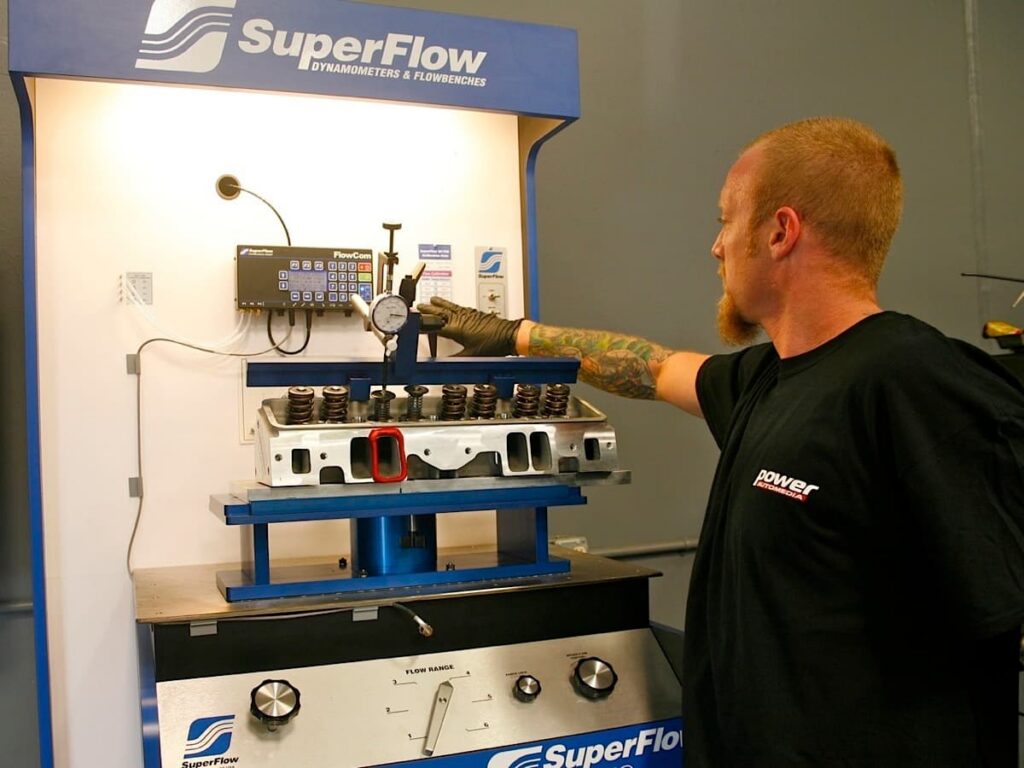
What a Flow Bench Actually Measures
A flow bench measures:

-
Airflow through a cylinder head
-
At a fixed pressure differential (typically 28 inches of water)
-
With steady, non-pulsed airflow
-
Without heat, fuel, combustion, or exhaust interaction
That is it.
It does not measure:
-
Air velocity under dynamic conditions
-
Cylinder filling during overlap
-
Fuel atomization
-
Combustion efficiency
-
Exhaust scavenging
-
RPM-specific demand
The engine, meanwhile, operates in a violently unsteady environment that changes thousands of times per minute.
Why Bigger Flow Numbers Don’t Automatically Make More Power
1. Airspeed Matters More Than Peak Flow
Engines do not run on peak flow at max lift—they run on average airflow across the usable lift curve.
A head that flows huge numbers at .800 lift but is lazy at:
-
.200
-
.300
-
.400
…may perform worse than a head with stronger mid-lift flow, especially in:
-
Bracket engines
-
Tight converter combos
-
Lower RPM applications
High peak flow with poor velocity often leads to:
-
Lazy throttle response
-
Narrow powerbands
-
Inconsistent ETs
2. Port Volume Must Match Engine Demand
Oversized ports are one of the most common—and expensive—mistakes.
Large ports:
-
Slow air velocity
-
Reduce signal to the carburetor or injector
-
Hurt cylinder filling at lower RPM
This is why smaller heads frequently outperform larger ones in real-world racing when:
-
RPM range is limited
-
Gear ratio is conservative
-
Converter stall is tight
Bigger is not better if the engine cannot use it.
The Flow Bench Ignores the Exhaust Side’s Role
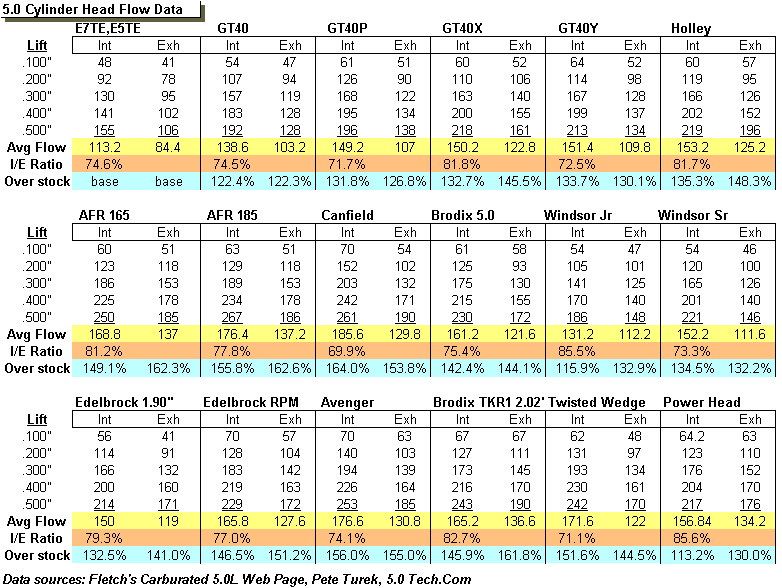
Many racers fixate on intake flow while ignoring the exhaust.
The exhaust system influences:
-
Cylinder scavenging
-
Overlap effectiveness
-
Intake charge motion
A head with slightly less intake flow but a strong exhaust-to-intake ratio can:
-
Make more usable torque
-
Broaden the powerband
-
Improve consistency
Flow benches test intake and exhaust separately. Engines do not operate that way.
Combustion Quality Beats Airflow Quantity
Two heads with identical flow numbers can produce vastly different results due to:
-
Chamber shape
-
Spark plug location
-
Flame travel
-
Quench characteristics
Better combustion efficiency means:
-
More power per unit of airflow
-
Less timing required
-
Reduced sensitivity to weather changes
Flow benches do not measure combustion quality.
Valve Motion and Camshaft Interaction Matter
Cylinder heads do not work alone.
The camshaft determines:
-
How long valves stay open
-
How quickly they reach peak lift
-
Where airflow is emphasized
A head designed for high lift may perform poorly with:
-
Mild cams
-
Hydraulic rollers
-
Limited rocker ratios
Likewise, an aggressive cam can expose weaknesses in a head with poor mid-lift flow.
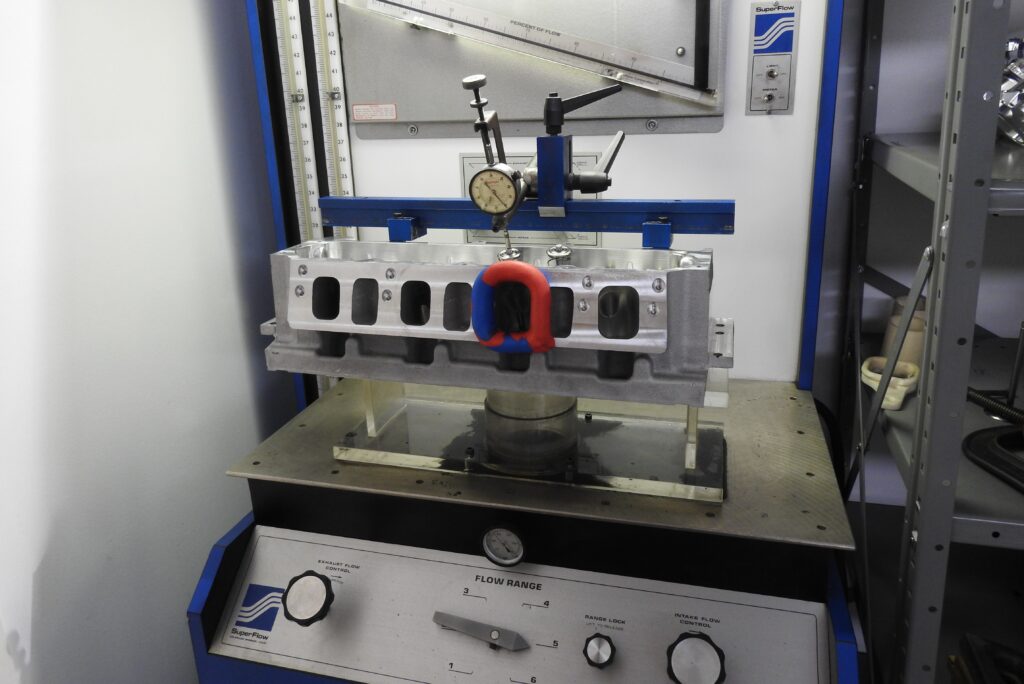
The head and cam must be designed as a system, not selected independently.
Why Flow Numbers Often Mislead Racers
1. Published Numbers Are Best-Case Scenarios
Most advertised flow numbers are achieved with:
-
Ideal test fixtures
-
No intake manifold
-
No exhaust system
-
No bore distortion
Real engines rarely see those conditions.
2. Flow Benches Don’t Simulate RPM
Engines demand airflow differently at:
-
6,000 RPM vs 9,000 RPM
-
Short tracks vs long pulls
-
Tight vs loose converters
A head that shines at high RPM may be a liability everywhere else.
3. “Winning” Heads Rarely Have the Biggest Numbers
Look at dominant bracket and index cars. Many run:
-
Modest flow numbers
-
Conservative port volumes
-
Heads optimized for velocity and repeatability
They win because the engine stays in its happy place more often.
Real-World Track Examples
-
Cars slow down after upgrading to “better” heads
-
MPH increases while ET worsens
-
Inconsistent 60-foot times appear after a head swap
These are classic signs of:
-
Port mismatch
-
Airspeed loss
-
Converter or gearing no longer matching the combo
The flow bench did not lie—the interpretation did.
The Right Way to Evaluate Cylinder Heads
Instead of asking:
“How much do they flow?”
Ask:
-
At what lift do they flow best?
-
What RPM range were they designed for?
-
What is the port volume?
-
What camshaft do they expect?
-
What converter and gearing will support them?
The best head is not the one with the highest number—it is the one that fits the entire combination.
Final Takeaway
Flow benches are tools, not truth machines.
They provide useful information, but they cannot predict performance in isolation.
In drag racing, engines are systems. When one part is selected without regard to the rest, performance suffers—no matter how impressive the flow sheet looks.
The track, not the bench, tells the final story.