Six years ago, Jimmy Taylor had never strapped into a race car.
Today, he is the fastest door-car driver on the planet—resetting expectations, bending physics, and doing it with a calm confidence that suggests he still hasn’t reached the bottom of the well. In a sport where careers often take decades to mature, Taylor’s rise has been meteoric. Not reckless. Not lucky. Just relentless.
And if you ask him where he’s headed next, he’ll tell you plainly: he’s not even close to done.

Bradenton: When the Tone Was Set Early
At the U.S. Street Nationals in January 2026, the Pro Mod field didn’t just deepen—it compressed. A 3.5-second run was no longer headline material; it was the price of admission.
Taylor rolled into Bradenton Motorsports Park and immediately planted his flag.
Low 3.55. No. 1 qualifier. A message sent.
“The car was just happy,” Taylor said. “Everything we were doing made sense. It responded the way it should.”
But the weekend wasn’t flawless. A head gasket issue ended his eliminations early—an abrupt stop that might frustrate most teams. Taylor shrugged it off.
“We weren’t 100 percent. Not even close,” he admitted. “And that’s actually the exciting part.”
With the bump spot in the 3.50s—and Taylor predicting a 3.58 or quicker just to qualify at the next race—the takeaway was clear: Pro Mod has entered a new era, and Taylor is helping lead it there.

Why This Car Is Different
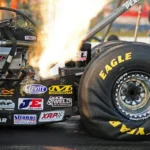
Taylor’s twin-turbo ’69 Camaro isn’t just fast—it’s difficult. Only two turbo cars were in the Pro Mod field at Bradenton, a telling statistic in a class dominated by superchargers.
Why do so many teams avoid turbos?
“They’re just harder,” Taylor said. “Staging, driving, tuning—it’s all more demanding.”
Harder, yes. But the payoff is historic.
Built on a PRC chassis, the car continues to evolve, and Taylor says there’s “so much left in it.” He’s confident the program will reach the 3.20s in the eighth-mile this year, and even more confident about a 4 second quarter-mile.
“The four-second pass? That’s coming,” he said. “Honestly, running the 3.20s is harder than going fours. We were on pace to do it at the World Cup if the track conditions hadn’t gone away.”
A new car is already underway—this one built by Jerry Bickel Race Cars—signaling that Taylor’s ceiling is still rising.

The People Behind the Numbers
Taylor is quick to deflect praise.
“I’ve had a lot of good people around me,” he said. “That’s the real reason I’m here.”
At the center of that circle is Carl Stevens Jr., whose engines and tuning philosophy have shaped the program’s trajectory.
“Carl brings a level of detail people don’t see,” Taylor said. “It’s not just power—it’s how and when the power shows up.”
Taylor is hands-on, but trust is the foundation.
“I give input, but I let Carl do what he does. That relationship matters.”
From Zero to 240: A Five-Year Origin Story
Taylor’s path into drag racing wasn’t conventional—it was accidental.
He met Jack Green, decided to dabble in 6.0 bracket racing, and immediately realized he wanted more. Helping Green at a Radial vs. the World event changed everything.
“I ended up leaving with Jack’s car,” Taylor laughed. “First pass was a 4.68.”
That turned into 4.70s. Then 4.40 “bad boy” racing. Then Radial vs. the World—where Taylor qualified with a 3.77 and raced down to a 3.67.
An invite to the Lion’s Den followed. He won it.
A ’67 Camaro with a ProCharger came next. While that car was being built, Taylor attended a No Prep Kings meeting and ran Seasons 6 and 7—learning, adapting, absorbing.
Then came Pro Mod.
“Jack took me under his wing. GPS Race Cars helped a ton. Carl started building engines. It all stacked.”
Five years removed from his first pass, Taylor is now redefining the outer limits of doorslammer performance.

What Comes Next
2026 will be a full plate.
Taylor plans to run NHRA Pro Mod—driving Bickel’s house car—alongside IHRA events. He’s also building cars for both Outlaw Pro Mod and sanctioned competition.
And in November?
Sponsors
Xtreme Racing Engines
precision turbos
Rossler transmissions
Fuel factory
Maxima racing oils
Neal chance converters
Atomizer fuel injectors
MGP connecting rods
Turbosmart
Hoosier tires
Summit racing
Diamond pistons
Kinetic engineering