
As with all tech articles. I do not claim to be an expert. My goal is that the article is educational to the majority of people, the article is not intended to challenge those with a very high level of understanding.
In drag racing, racers often chase horsepower when their problem is actually happening long before the engine ever has a chance to shine.
The first sixty feet of the racetrack is where races are won and lost, and few components influence that critical moment more than the rear shocks.

Yet shock tuning remains one of the most misunderstood adjustments in the pits.
Many racers will spend thousands of dollars searching for horsepower while overlooking the simple reality that if the tire isn’t planted correctly, that power never makes it to the racetrack.
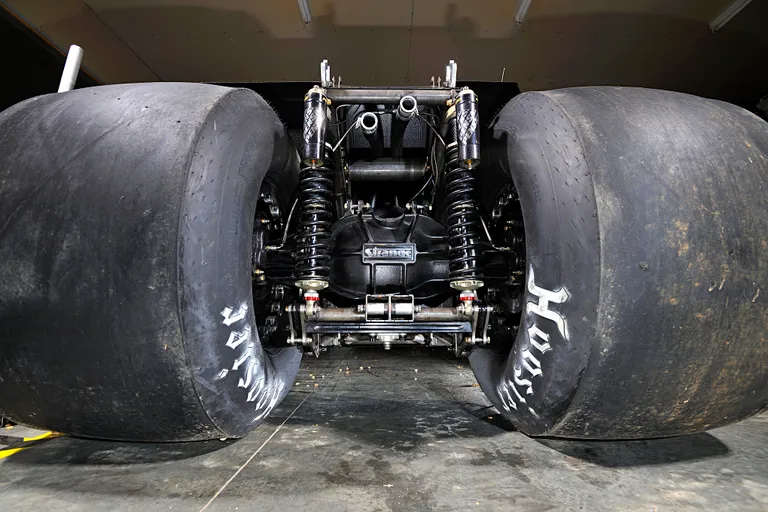
For most door cars running a 4-link or ladder bar suspension, the rear shocks are one of the primary tools used to control how the tire is loaded when the car launches.

Understanding how those shocks work can turn a frustrating car into a predictable one.
What a Shock Actually Does
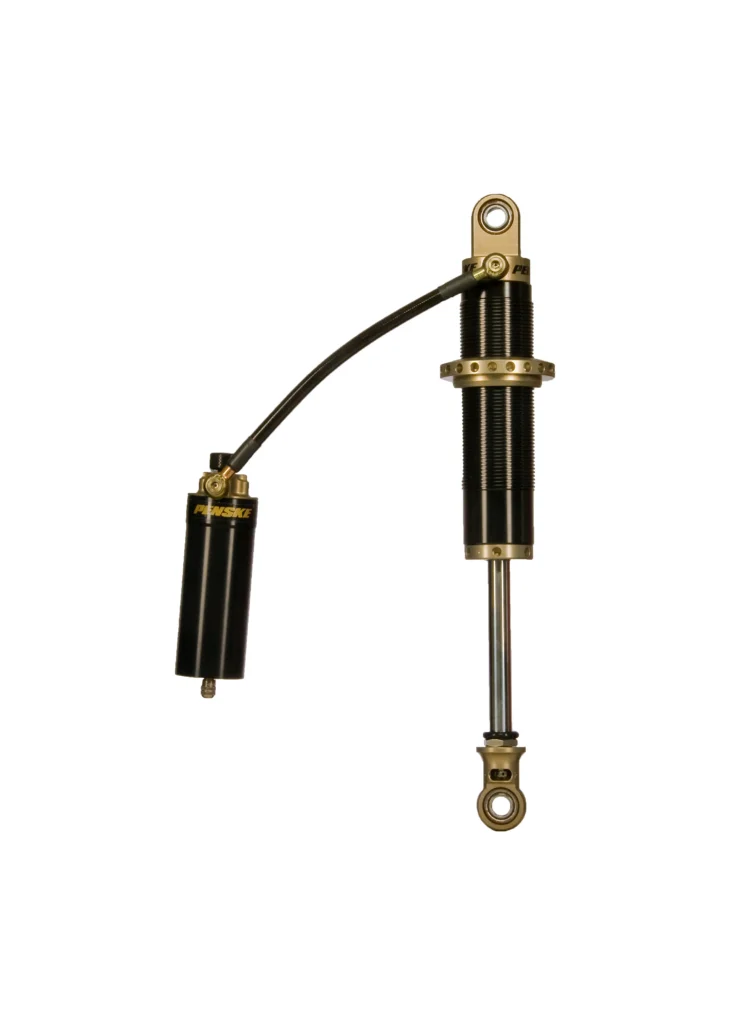
A “shock” does not hold the car up. The springs do that.
The shock’s job is to control the rate of suspension movement.
In drag racing terms, shocks control how quickly weight transfers to the rear tires when the car launches.
When the transbrake releases, inertia instantly pushes weight toward the rear of the car. That weight transfer plants the tire and creates traction.
The key variable is how quickly that weight arrives at the tire (and how long it stays there).
If the suspension moves too quickly, the tire can be shocked and lose grip. If the suspension moves too slowly, the tire never receives enough load and the car spins.
Shock tuning is how racers control that balance.
Double Adjustable Rear Shocks
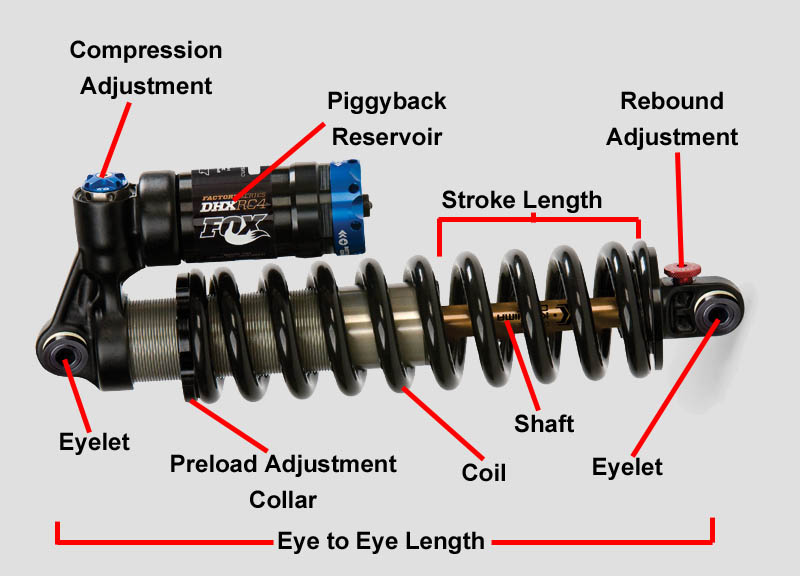
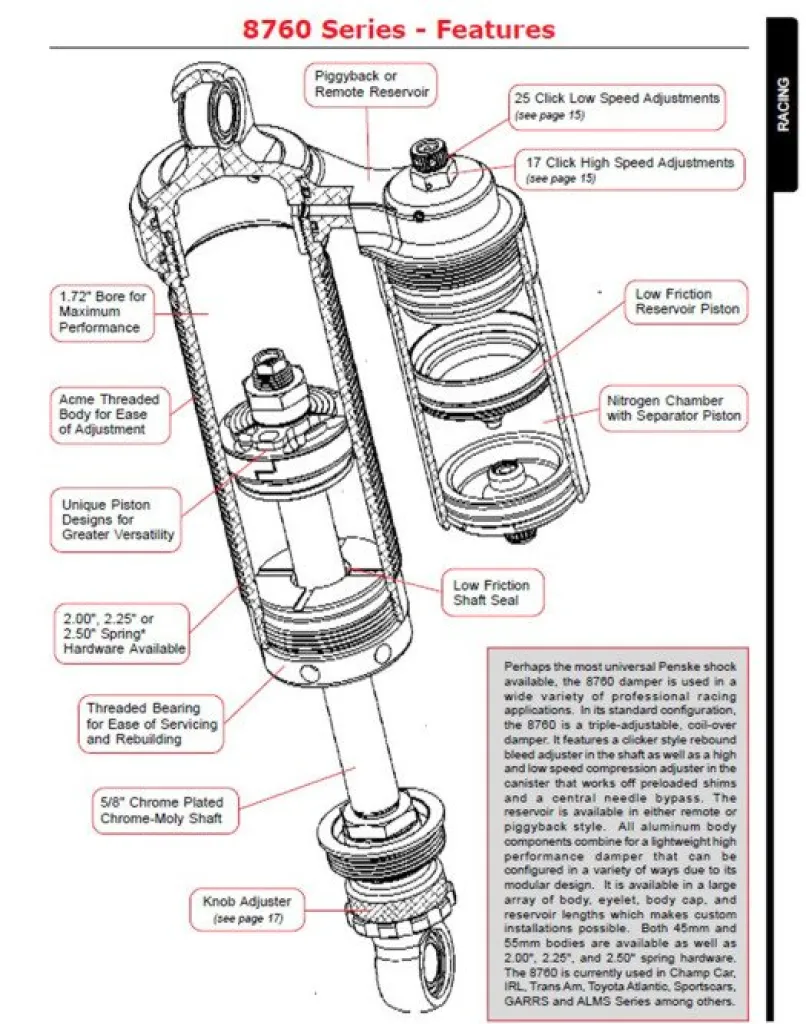
Most modern drag racing shocks are double adjustable, meaning they allow separate adjustment of:
• Rebound (extension)
• Compression
Some higher-end shocks are four-way adjustable, which separates high-speed and low-speed circuits for each direction, but the basic concepts remain the same.
On a typical 4-link or ladder bar car, the rear suspension separates on launch. That means the rear end housing moves downward relative to the chassis while the body of the car rises.
This separation helps plant the tire.
The shocks control how fast that separation happens and how long the suspension stays loaded.
Rebound: The Most Important Adjustment
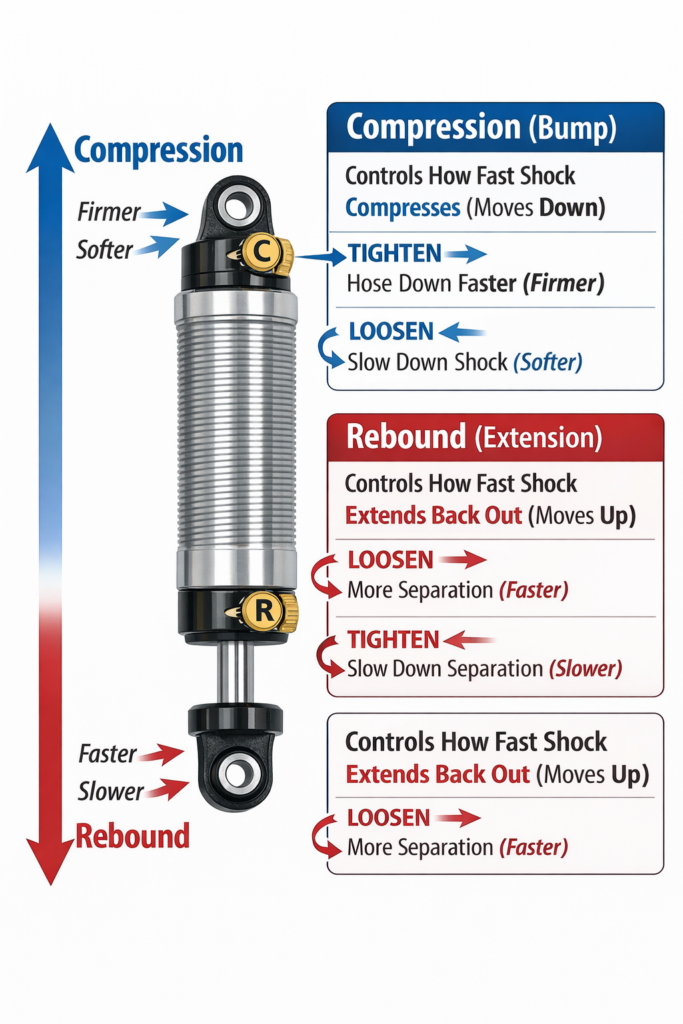
Rebound controls how quickly the shock extends after the car launches.
In other words, rebound controls how fast the rear suspension separates.
Because that separation is what loads the tire, rebound is often the primary adjustment racers use to tune traction.
Loosening Rebound
Loosening rebound allows the shock to extend faster.
This causes:
• Faster rear separation
• A harder hit to the tire
• More immediate weight transfer
When rebound is too loose, the tire can be hit too violently, which may cause:
• tire shake
• aggressive tire wrinkle
• unstable driveshaft RPM
When the rebound is loose, the separation happens quickly, but comes back down quickly. (fast on/fast off)
Tightening Rebound
Tightening rebound slows the rate of extension.
This produces:
• slower rear separation
• a softer hit to the tire
• smoother weight transfer
A tighter rebound setting often makes the launch more controlled and more stable.
Because the shock resists movement, the suspension also tends to stay in the separated position longer, which keeps load on the tire further down track. (slow on/slow off)
This is why racers often say tighter rebound helps the car stay planted longer.
However, if rebound becomes too tight, the suspension cannot separate enough and the tire never receives enough load. When that happens, the car may spin or produce slow 60-foot times.
Rebound and Wheel Speed
Shock settings can also influence wheel speed immediately after launch.
A tire that is hit very hard will typically show slower initial wheel speed because it is planted aggressively.
A tire that is hit more softly may allow wheel speed to rise quicker because the tire is slipping slightly.
This is why driveshaft sensors have become so valuable in modern drag racing.
A properly tuned car will show a smooth, progressive rise in driveshaft RPM, rather than a spike or a flat line.
Rebound adjustment is often the first tool racers use to shape that curve.
Compression: Controlling What Happens Next
Compression controls how quickly the shock compresses after the suspension has separated.
In a drag car, this affects what happens after the initial hit.
Compression influences:
• how the chassis settles
• how the tire stays loaded down track
• stability during gear change or power application
Loosening Compression
Looser compression allows the rear suspension to compress easier.
This can help the tire stay planted on marginal track conditions and allows the suspension to absorb bumps or track irregularities.
Tightening Compression
Tighter compression slows how quickly the suspension compresses.
This can:
• stabilize the car
• control excessive squat
• help maintain tire shape in high horsepower cars
While rebound often controls the initial hit, compression helps determine how stable the car remains after that hit.
Understanding “Clicks”
Each click slightly changes the internal damping.
In practical tuning terms:
• 1–2 clicks – very small change
• 3–4 clicks – noticeable change
• 6+ clicks – major change
Experienced chassis tuners almost never make large adjustments at once.
Instead they move the shock a few clicks at a time, make a pass, and observe the result.
Making several changes at once makes it nearly impossible to understand what actually fixed—or worsened—the problem.
Reading What the Car Is Telling You
Launch behavior provides clues about shock settings.
Tire Shake
Violent shaking shortly after launch usually means the tire is being hit too aggressively. (loose rebound setting hits the tires harder, but does not allow for as much wheel speed)
Possible adjustments include:
• tightening rear rebound
• tightening front extension
• softening the initial suspension hit
Immediate Spin
If the car spins immediately without shaking:
Possible solutions may include:
• loosening rear rebound
• increasing weight transfer
• hitting the tire harder
Lazy 60-Foot Times
If the car leaves smoothly but the sixty-foot is slow:
Possible solutions may include:
• loosening rear rebound slightly
• increasing separation speed
• allowing the tire to be hit harder
Consistency Wins Races
For many racers—especially bracket racers—the goal is not necessarily the fastest possible launch.
The goal is repeatability.
A car that repeats its sixty-foot time run after run gives the driver a predictable machine to race with.
In a sport where races are decided by thousandths of a second, shock tuning is less about chasing speed and more about achieving balance.
When the suspension works correctly, the car leaves smoothly, the tire stays planted, and the driver hardly notices the work being done underneath.
And that’s exactly how it should be.