
By Kline Whitley
A .003 green and a .003 red are only six thousandths of a second apart. One looks great on a time slip. The other can end your day banging on the steering wheel at the 60 foot cone.
That is the world we compete in. And at the end of the day, cutting a light comes down to consistency. Being fast matters, but being able to repeat matters most. Anybody can hang a great number on the board once. The challenge is knowing what you are bringing to the starting line the next round.

Now, before anybody mistakes this for a master class from somebody who has it all figured out, let me clear that up: I can look just as dumb as the rest of us. I can be on it all day and then have a “squirrel!” moment that makes it look like I fell out of the car.
Like most racers, I usually know what I am supposed to do. Executing it is where things get interesting.
Consistency builds confidence. Confidence helps us commit. But somewhere between believing we can do it and actually doing it is something that deserves more attention: composure.
First, though, we have to stage the car.
We can discuss mindset all afternoon, but if we put the car in the beams differently every round, we are changing the problem we are asking ourselves to solve.
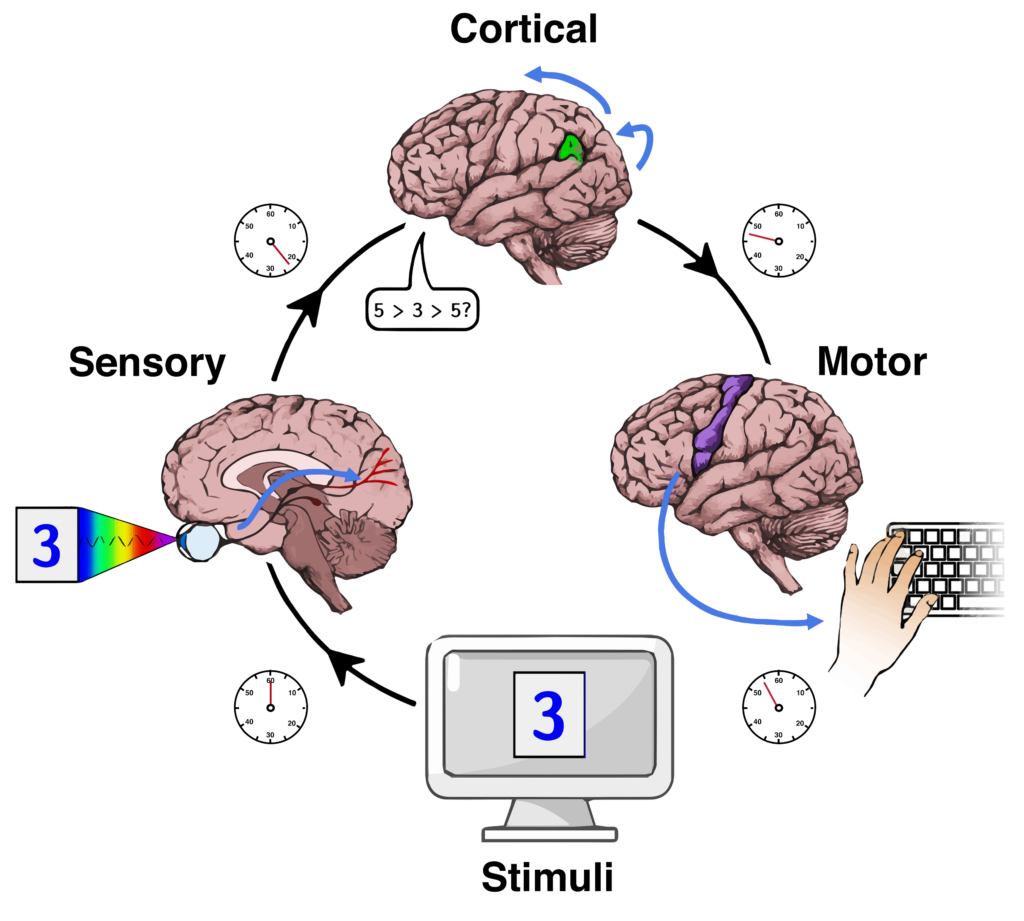
The reaction time on the slip is not an isolated measurement of how quickly your brain responds. It reflects when the car clears the staging beam relative to the green. Your response, the car’s response, and the distance it must move to clear that beam all contribute. Moving farther into the beam changes that distance. NHRA’s own glossary recognizes the connection between deeper staging and being closer to a red light.[1]
In other words, you can do the same thing with your hand or foot and still get a different number if the car starts from a different position.
Give yourself a repeatable staging procedure. Keep the relevant mechanical variables consistent, too. Before deciding your head is the problem, make sure you have not been moving the starting point.
Then look at the pattern, not just the best light.
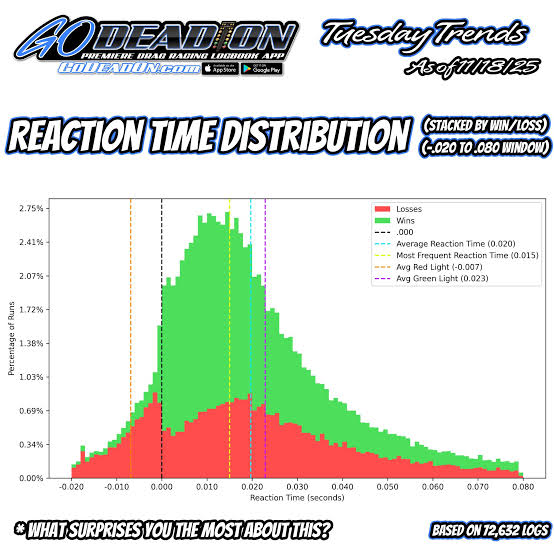
Imagine one racer goes .002, .028, .009, and .035. Another goes .014, .016, .013, and .015. The first racer has the best individual light. The second has a much clearer picture of what to expect.
That does not mean we should all aim for .015. It means a tight group gives you something useful to work with. If your combination allows an appropriate adjustment, you can work on where that group sits. Moving a scattered group closer to zero also moves some of those scattered lights closer to red.
The goal is a competitive light you can repeat, with an honest understanding of your margin for error.
This is where confidence enters the conversation.
I often think of the old saying, “Speak softly and carry a big stick.” Picture a room where a fight might break out. The person I would be watching is the one who seems completely unbothered by all the noise, not the person being the loudest.
That is the kind of confidence I am talking about at the racetrack. Quiet. Prepared. Comfortable enough with the job that every change around you does not become a change inside you.
Lane change? Still confident. Oil down in front of you and a long cleanup? Still confident. No split? Still confident.
Of course, confidence does not mean ignoring conditions. A lane change may call for a legitimate adjustment. Track preparation and safety still matter. Being unbothered means dealing with what requires attention, then returning to the job without carrying the frustration into the beams.
You can care deeply about the outcome and still stay composed enough to execute.
For me, that includes being relaxed when I hit the tree. Alert, engaged, and ready, with no more tension than the job requires. There is a difference between being ready to release the button and sitting there wound so tight that you are trying to force a good light into existence.
It is easy to mistake that tension for focus. The round matters, so we grip harder, tighten our shoulders, and tell ourselves to try harder. But extra effort is only useful if it helps us repeat the action. Feeling more intense does not automatically mean we are performing better.
Different racers will find their best level of intensity in different places. I would judge it by the pattern on the slips. If a relaxed, familiar approach produces a tighter group, that is the approach to trust when the money gets bigger. You do not need to manufacture tension to prove you care.
There is science behind why that can be difficult. In experiments involving golf putting, psychologists Sian Beilock and Thomas Carr found support for a familiar problem: pressure can cause us to consciously supervise a practiced skill that normally runs without step-by-step attention. That extra monitoring can interfere with performance.[2]
Those experiments were not drag races. Still, the lesson is worth considering the next time you stage for a big round and suddenly start trying to engineer every detail of a release you have made thousands of times.
The final round is a rough place to give yourself a brand-new driving lesson.
That is why I like three words: Focus. Commit. Execute.
Focus on the cue you have trained to use. Commit to the plan you made before staging. Execute the action you practiced.
“I need to be .000” tells you what result you want. It does very little to tell you how to produce it. A short, familiar cue gives you a job you can actually perform.
A routine helps make that job familiar.
In a study of 284 free throws during NBA playoff games, players made approximately 84% when they followed their usual behavioral sequence, compared with approximately 71% when they departed from it. That was an observational study, so it does not prove the routine caused the difference. It does offer a useful example of routine and performance being connected under competitive conditions.[3]
Interestingly, taking the same amount of time was not what distinguished successful shots. The behavioral sequence mattered more in that study. For racers, I would take that as a reason to build a routine you can return to after an interruption, rather than one that requires the entire event to run on your schedule.
Your routine might include your equipment checks, seating position, staging procedure, where you direct your eyes, and a brief cue before execution. Keep it practical. Practice it until it is familiar. It should help you prepare without becoming another complicated task to manage.
An oil down will happen. Somebody will take longer than you expected. The lanes will get shuffled. Have a way to reset when they do.
While safely waiting, that might mean a comfortable breath, releasing unnecessary tension in your shoulders, and returning your attention to the next step. You do not have to win an argument with the delay. You have to be ready when the delay ends.
I would also practice restarting. On a practice tree, take a break, interrupt the session, then come back and use your routine. Record the whole set, including the ugly ones. A practice tree cannot reproduce every variable in the race car, but it gives you a place to rehearse returning your attention to the task.
Make repeatability the score. If you only remember the .000 and forget the three reds around it, you are practicing selective memory.
There is another part of this conversation that is less exciting than a new technique: sleep.
In a controlled study, restricting time in bed to four or six hours per night for two weeks produced accumulating cognitive performance deficits, including problems on an attention task. Participants’ feelings of sleepiness did not fully track the worsening performance.[4]
That should get our attention in a sport decided by thousandths. Feeling accustomed to short sleep does not establish that your performance is unaffected.
We will spend hours making sure the car is ready, then treat the person driving it like an accessory. Preparation needs to include the driver. Sleep, regular meals, and planning for a long day deserve a place beside the battery charger and tire-pressure gauge.
Even with preparation, a bad light will happen. What you do with it matters.
My suggestion is to review it while the details are fresh: Did I stage differently? Did something change mechanically? Did I rush? Was my attention somewhere else? Was there an identifiable problem, or am I trying to build a whole theory around one time slip?
Write down what you can use. Make a justified adjustment when needed. Then give the next run your attention.
One bad light is information. Turning it into “I cannot hit the tree today” gives that one number more authority than it deserves. The same applies to a great light. A .001 does not make you invincible, and a .030 does not erase everything you know.
That space between confidence and execution is also part of what drew me to developing RevMind through my company, Redstone Performance. The idea behind it is supporting focus and composure: being present for the moment without feeling a need to get more wound up simply because the stakes are higher.
As a pharmacist and a racer, I also think it is important to be precise about the evidence. L-theanine, one of RevMind’s ingredients, has been studied for stress responses. A small placebo-controlled study involving 12 participants found reduced heart-rate and salivary immune-marker responses during a stressful mental-arithmetic task.[5]
That is ingredient research in a laboratory. It does not establish that RevMind improves drag-racing reaction times, prevents red lights, or makes a driver more consistent. I would not present it as that. A supplement cannot do your staging, practice, or preparation for you.
What interests me is the broader goal of staying composed enough to use the skills you have worked to develop. The routine and the work still come first.
I will continue working on that myself. There will probably still be a round where I have been on it all day and suddenly look like somebody handed me the keys five minutes ago.
But the target is clear: put the car in the beams the same way, bring a repeatable process, and trust it enough to let yourself execute.
The purse can change. The opponent can change. The wait can change.
The tree still gives you the same job.
Focus. Commit. Execute.
Sources
- NHRA. NHRA Glossary: Reaction Time and Deep Stage. https://nhra.com/nhra-101/nhra-glossary
- Beilock SL, Carr TH. On the fragility of skilled performance: What governs choking under pressure? Journal of Experimental Psychology: General. 2001;130(4):701–725. https://pubmed.ncbi.nlm.nih.gov/11757876/
- Lonsdale C, Tam JTM. On the temporal and behavioural consistency of pre-performance routines: An intra-individual analysis of elite basketball players’ free throw shooting accuracy. Journal of Sports Sciences. 2008;26(3):259–266. https://pubmed.ncbi.nlm.nih.gov/17943592/
- Van Dongen HPA, Maislin G, Mullington JM, Dinges DF. The cumulative cost of additional wakefulness: Dose-response effects on neurobehavioral functions and sleep physiology from chronic sleep restriction and total sleep deprivation. Sleep. 2003;26(2):117–126. https://pubmed.ncbi.nlm.nih.gov/12683469/
- Kimura K, Ozeki M, Juneja LR, Ohira H. L-Theanine reduces psychological and physiological stress responses. Biological Psychology. 2007;74(1):39–45. https://pubmed.ncbi.nlm.nih.gov/16930802/