Tom Henninger has spent his life building race cars, fabricating championship-level components and chasing records on two wheels. Now, alongside his wife Taylor, he is building something far more important: a way for children in foster care to see that their current circumstances do not have to define their future.
Drag racing regularly talks about reaching the next generation.
We talk about getting children into the grandstands, putting young people behind the wheel and introducing new families to the sport. We talk about how racing needs fresh blood, new ideas and another generation willing to carry it forward.

But too often, we wait for that next generation to find us.
Fueling Foster Care intends to go find them.
The North Carolina-based nonprofit is being built around a straightforward but potentially life-changing idea: bring children and families from the foster-care system into the racing world, give them an authentic experience at the track and introduce them to people, careers and possibilities they may never have known existed.

The race motorcycle will attract attention. The NHRA stage will give the organization a platform. The sponsors will make the work possible.
But the children are the reason for all of it.
For founder Tom Henninger, that mission is deeply personal.
A Story Coming Full Circle
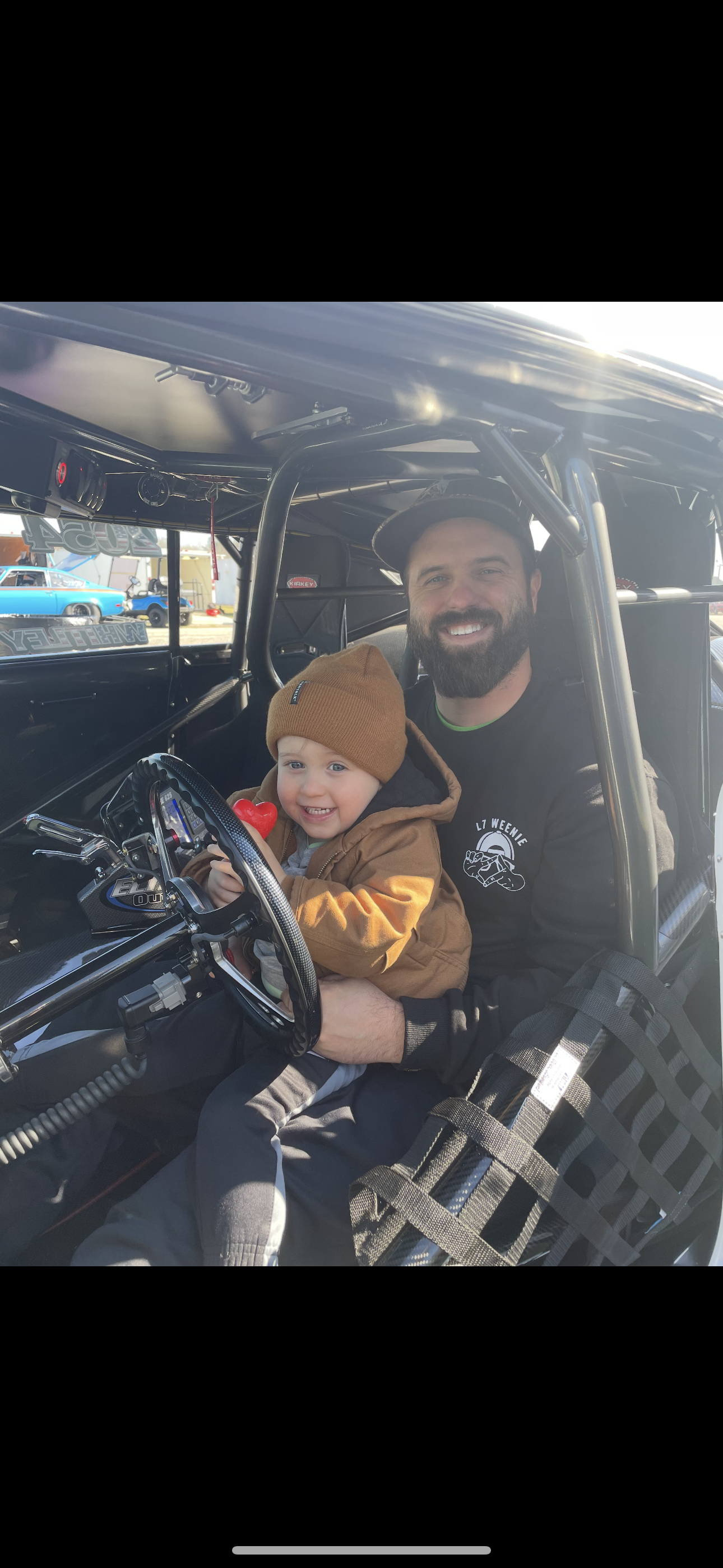
Tom and his wife, Taylor, have been licensed foster parents in North Carolina for approximately three years. They have welcomed multiple children into their home during that time.
Their current placement came to them when he was only seven weeks old. On August 6, he will turn two, and Tom and Taylor are now preparing to adopt him.
For Tom, it represents a remarkable full-circle moment.
Tom was adopted himself. His biological mother placed him for adoption at birth when she was not in a position to raise him, and he was raised by two people he describes simply as wonderful parents.
He never considered them anything other than his mother and father.
“I never thought twice about them not being my mom or dad,” Henninger said.
That personal history made foster care and adoption familiar to Tom long before he and Taylor opened their own home. Taylor had always wanted children. When they learned they could not have biological children together, foster care became the path they chose.
It was not simply an alternative route to parenthood. It became part of their purpose.
Now, the child who entered their home as a seven-week-old infant is preparing to become their son permanently.
“It’s kind of going full circle now,” Henninger said.
Fueling Foster Care grew from that same intersection of personal experience, family and opportunity.
Racing Gave Tom a Direction
Tom did not grow up in a traditional racing family.
His father worked as a financial analyst for IBM and hoped his son would become an engineer. Tom earned good grades in high school and enrolled in community college, but he quickly realized that the traditional academic route was not where he belonged.
He lasted roughly half a semester.
What he did know was that he wanted to work on cars.
When Tom decided to attend technical school, his father supported the decision—but with a condition. If Tom wanted a career working on cars, he needed to start working immediately.
So, while waiting for school to begin, Tom took a job at Jiffy Lube and spent six months working underneath cars in the service pit.
In 2004, he graduated from what was then known as the NASCAR Technical Institute in Mooresville, North Carolina. The Mooresville campus remains the country’s exclusive NASCAR educational provider, offering specialized instruction in subjects including engines, fabrication, welding, aerodynamics and pit-crew operations.
After graduation, Tom worked at a performance shop in Florida before returning to North Carolina for an opportunity with a NASCAR team.
He eventually worked for multiple NASCAR organizations and experienced life at the track and in the pits. Still, drag racing was always the form of motorsports that pulled at him the hardest.
Tom moved into specialized fabrication and exhaust work, contributing to projects across several forms of racing. His résumé includes work connected to Matt Smith Racing, Elite Motorsports, Flyin Ryan Oehler, Shane tuckerm and even rally-car programs.
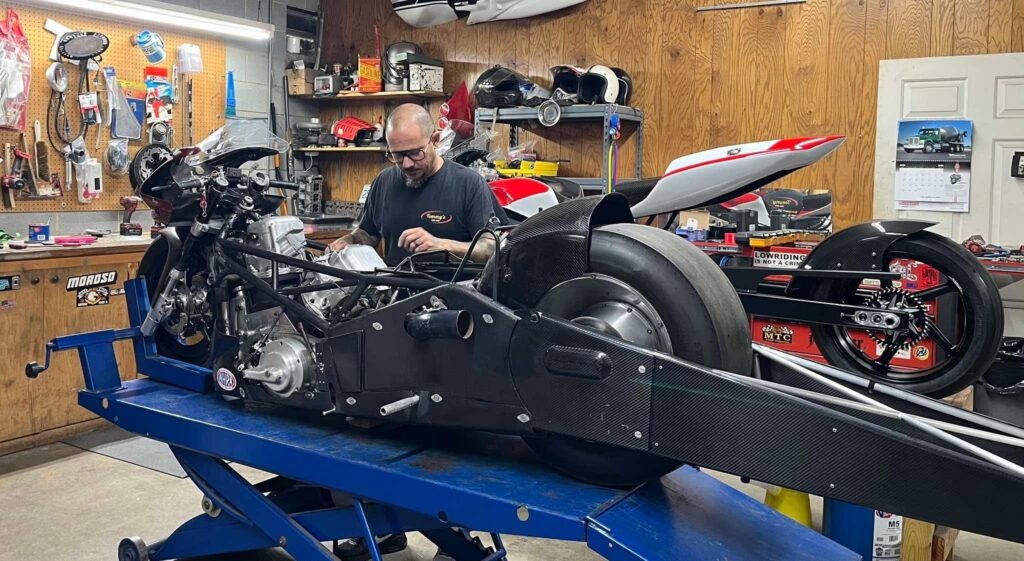
Today, he operates his own metal-fabrication business. His public business profile describes a focus on custom and high-performance metal fabrication, including specialized Inconel exhaust systems.
For approximately a decade, Tom said, his shop has supplied headers to Elite Motorsports—an opportunity he never could have imagined when he was lying in the pit at Jiffy Lube waiting for technical school to start.
Racing gave him a skill.
That skill became a profession.
The profession became a business.
And the business gave him a place within some of the highest levels of the sport.
The Chop Shop Special
Tom has not experienced racing only from the fabrication side.
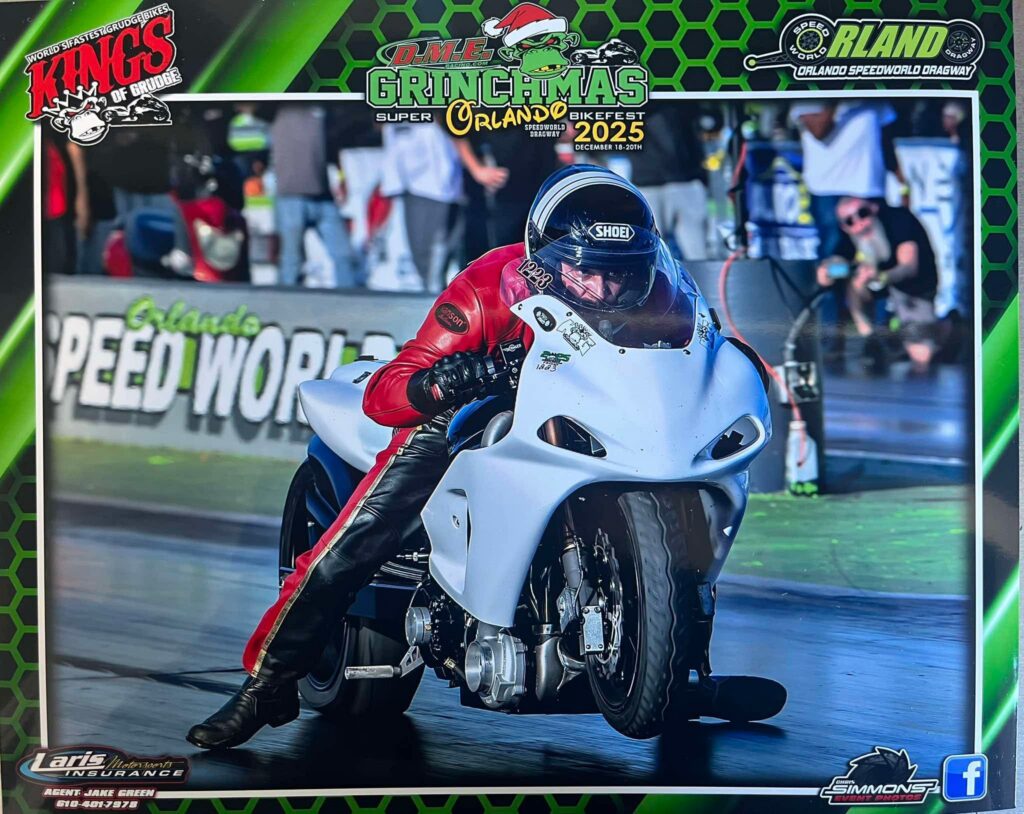
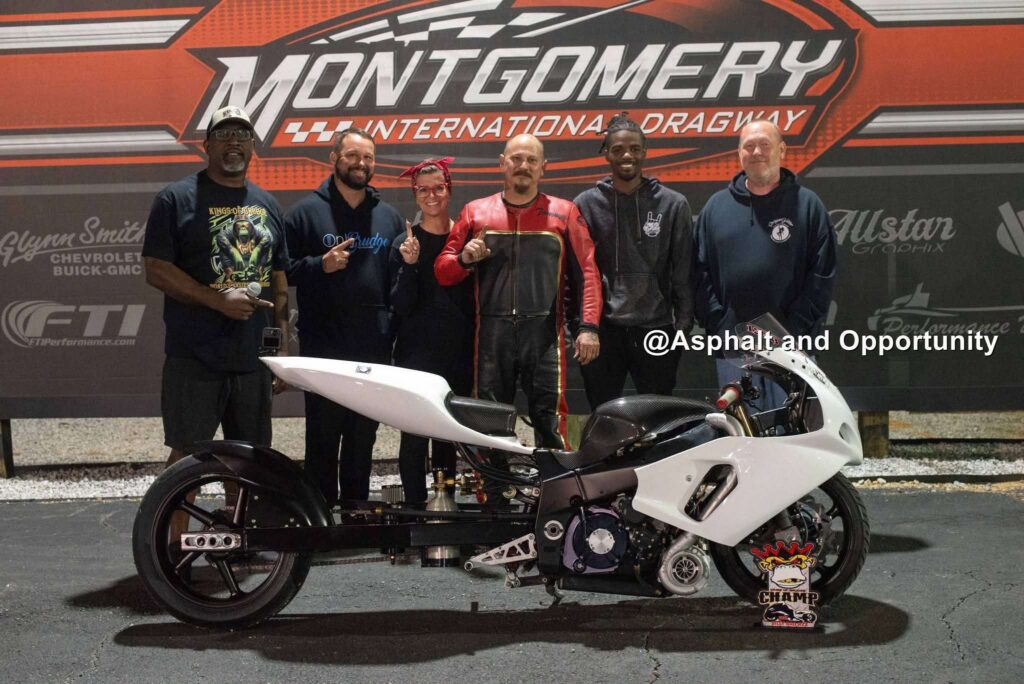
He built and raced his own Suzuki motorcycle in the Kings of Grudge series, where he said he won his class championship three consecutive seasons and established multiple performance records.
The motorcycle became known as the Chop Shop Special, and Tom became a consistent force in the Billy Bad Azz category. Public results from the 2024 Kings of Grudge season list Tom and the Chop Shop Special as the Billy Bad Azz winner at Da Bayou Bikefest at No Problem Raceway.
His racing success eventually left him searching for the next challenge.
Tom had always dreamed of racing at the NHRA Pro Stock Motorcycle level. For years, that dream and his work in foster care existed as separate parts of his life.
Then, a few months before our conversation, those worlds began to come together.
What Happens When a Child Sees the Racetrack?
Tom and Taylor had taken children in their care to races at tracks such as zMAX Dragway in Charlotte and Bristol Dragway in Tennessee.
Tom saw their reactions.
He saw the sensory overload of a child experiencing the noise, vibration, speed and energy of a major racing facility for the first time. He saw the excitement of walking through the pits, looking at the transporters and being close enough to the machinery to understand that the people on television were real people doing real jobs.
He also recognized that many children in foster care may never encounter that world without someone deliberately opening the door.
Many foster families simply have no connection to motorsports. They may be loving, supportive homes, but racing is not part of their lives. Without an organization creating the opportunity, a trip to an NHRA national event may never happen.
That realization became the beginning of Fueling Foster Care.
The immediate goal is to work with local social-services departments near the racetracks the team visits. At each event, the organization hopes to host approximately five to ten children, along with their foster families or caregivers, and give them an authentic weekend at the track.
They will not simply receive a ticket and be pointed toward the grandstands.
Tom wants them in the pits.
He wants them meeting drivers, talking to crew members, seeing the motorcycles up close and experiencing the community surrounding the sport.
Most importantly, he wants them to understand that a racetrack contains far more career opportunities than the person wearing the firesuit.
“There’s just an amazing amount of things that you can do,” Henninger said. “Even when I was in racing, I didn’t see the big picture of all the things I could have done rather than just be a metal fabricator.”
A professional racing operation needs mechanics, fabricators and tuners. It also needs truck drivers, hospitality workers, cooks, photographers, videographers, graphic designers, public-relations professionals, social-media managers, accountants and marketing specialists.
A child may walk into the track believing that racing has nothing to offer unless they can become a driver.
Fueling Foster Care wants that child to leave understanding that an entire industry exists around the driver.
More Than Entertainment
A day at the racetrack cannot erase trauma.
It cannot repair every broken relationship, guarantee a permanent home or solve the deeply complicated problems surrounding the foster-care system.
Fueling Foster Care is not pretending otherwise.
But a meaningful experience can introduce a child to a passion. A passion can create motivation. Motivation can become discipline. Discipline can become education, employment and an entirely different future.
Sometimes a young person does not need to be shown every step of the journey.
Sometimes they simply need to be shown that another road exists.
That becomes especially important for older foster youth approaching adulthood.
Federal foster-care data continue to show that approximately 15,000 young people leave care through emancipation in a typical recent year—meaning they enter adulthood without reunification, adoption or another legally permanent family connection.
Tom does not want Fueling Foster Care to stop at race tickets.
The organization’s longer-term vision could include scholarships, technical training, mentorship and commercial driver’s license programs. For a young adult leaving foster care, a CDL or a skilled-trades credential could represent more than employment. It could mean stability, independence and a concrete way to begin building a life.
Tom is also interested in working with tool manufacturers to place basic tool kits into children’s hands.
Many organizations already do essential work providing clothing, backpacks, school supplies and other necessities. Tom wants Fueling Foster Care to complement those efforts by giving children something that invites them to build, repair and explore.
A wrench or socket set may look like a simple gift.
In the right hands, it can become a first introduction to mechanical aptitude.
It can create the satisfaction of taking something apart, understanding how it works and successfully putting it back together.
For a child who has experienced decisions constantly being made around them, building or repairing something can also provide a rare sense of control and accomplishment.
Building a Team Around the Mission
Tom understood that Fueling Foster Care needed credible people who believed in both the mission and the sport.
One of his first choices for the organization’s board of directors was Richard Gadson.
That choice was not based solely on Gadson’s racing résumé.
Gadson is the reigning 2025 NHRA Mission Foods Pro Stock Motorcycle world champion, but he has also used his platform to bring young people from Big Brothers Big Sisters to NHRA events. NHRA reported that Gadson hosted Big Brothers Big Sisters representatives and their “Littles” at multiple national events, later honoring the first anniversary of that track-experience initiative.
Fueling Foster Care publicly announced Gadson as a member of its board, noting the natural connection between the organization’s mission and the mentorship work he was already doing.
Tom also recruited a board member. They are a veteran social worker within the local community in North Carolina where he and Taylor are licensed foster parents. That experience will be critical as the organization begins coordinating responsibly with agencies in different regions.
The intention is not to arrive in a city and independently search for children to attend.
Fueling Foster Care wants to work through the proper local departments and organizations, allowing experienced professionals to identify children and families who could benefit from the opportunity while protecting their privacy and needs.
A Pro Stock Motorcycle With a Different Purpose
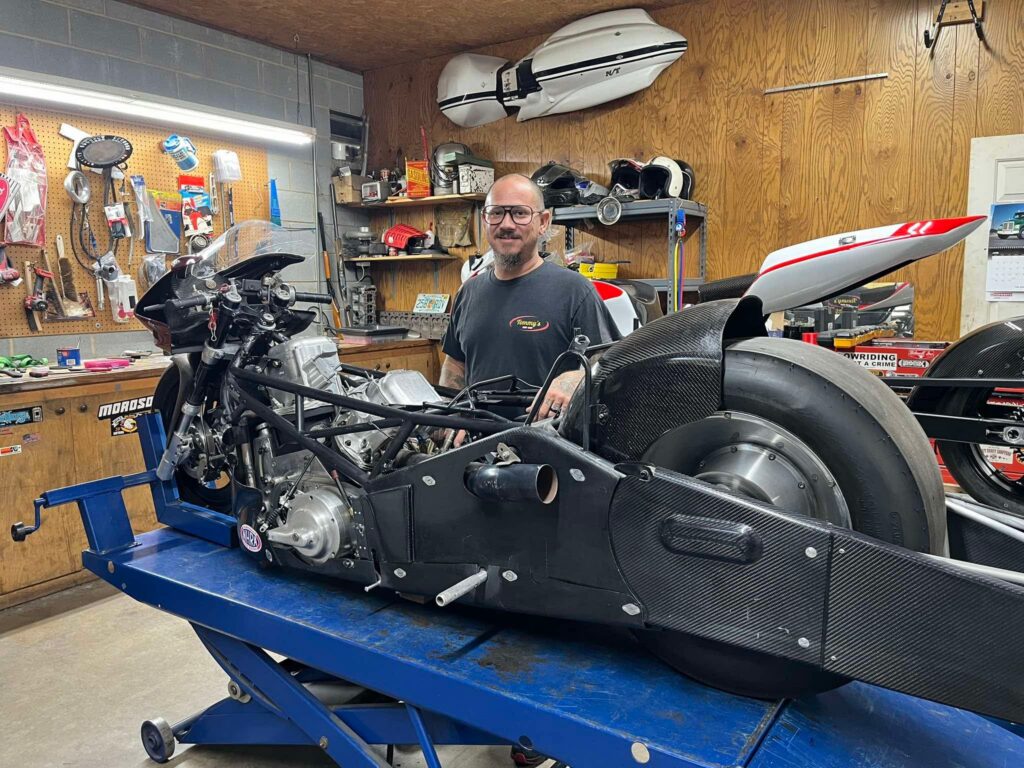
Fueling Foster Care has already acquired the foundation of its racing operation.
Tom purchased the former Junior Pippin Pro Stock Motorcycle program, including the motorcycle, engines, transmissions and supporting equipment.
The equipment had been sitting, so the motorcycle will need to be thoroughly inspected, refreshed and prepared before Tom can begin testing. He must also adjust from racing a non-wheelie-bar Suzuki to riding a purpose-built Pro Stock Motorcycle.
That transition will require time, testing and licensing.
The initial goal is to test and complete the licensing process before attempting an NHRA debut in Gainesville or Charlotte in 2027, assuming the organization can secure the funding and resources necessary.
Tom would eventually like to attend as many races as funding allows.
Each stop would create another opportunity to work with a local foster-care agency and bring a new group of children and families into the sport.
The motorcycle will be painted and designed around the Fueling Foster Care identity. Instead of repeatedly redesigning the bike around one-race sponsorship arrangements, Tom wants the mission to remain visually central.
Supporting companies will still receive space on the motorcycle, wheelie bars and side panels. The team also plans to display sponsors and community partners through a large television at the back of the trailer and through the organization’s website.
Tom is candid that he cannot yet promise a traditional, easily measured marketing return.
The organization is new. The race program is still being built. Attendance, media exposure and competitive performance will grow over time.
The immediate return is simpler.
A sponsor will be helping children experience something new, discover potential careers and possibly find the interest that changes the direction of their lives.
A Dream That Became Bigger Than Racing
Tom does not hide the fact that racing Pro Stock Motorcycle is his dream.
It should be.
There is nothing wrong with wanting to compete at the highest level, especially after spending decades developing the skills and experience necessary to reach it.
What separates this project is that Tom found a way to make his dream carry other people with it.
“For us to be racing is my dream,” Henninger said. “But then also being able to bring these kids around and maybe change some lives—I mean, it really can’t get better than that.”
Since our interview, Fueling Foster Care has updated its public profiles to identify the organization as a recognized 501(c)(3) nonprofit. Its stated mission is to provide memorable experiences through racing that help “fuel” the futures of children in foster care.
That milestone opens the door for tax-deductible charitable giving and gives companies, racers and supporters a formal way to become part of the program.
But Fueling Foster Care will need more than financial donations.
It will need race teams willing to welcome children into their pit areas.
It will need drivers willing to pause and have a real conversation.
It will need technical schools, trucking companies, fabrication shops and tool manufacturers willing to show young people what a career could look like.
It will need tracks, sanctioning bodies and media outlets willing to continue telling the story as the organization grows.
Most of all, it will need the racing community to understand the opportunity in front of it.
Racing Can Give Someone a Place to Belong
Racers know what this sport can do for a person.
Racing teaches patience because success rarely arrives immediately.
It teaches responsibility because improperly prepared equipment can hurt someone.
It teaches accountability because the scoreboard does not care about excuses.
It teaches problem-solving, teamwork, mechanical ability, emotional control and the value of showing up prepared.
It also gives people a community.
For children who have experienced instability, changing homes or uncertainty about where they belong, that community may matter as much as anything they see traveling down the racetrack.
Not every child invited to an event will become a racer.
They do not need to.
One may become a welder.
One may become a photographer.
One may decide to drive a transporter, study engineering, pursue marketing or attend a technical school.
Another may simply have an unforgettable weekend during a difficult chapter of life.
That still matters.
The racing community cannot solve the entire foster-care system. Fueling Foster Care cannot reach every child or guarantee what happens after someone leaves the racetrack.
But it can open a gate.
It can introduce a child to people who build things, solve problems and depend on one another.
It can show them an industry filled with opportunities they did not know existed.
And it can deliver a message that every young person deserves to hear:
Your story is not finished.
There are places you have not seen, skills you have not discovered and people you have not met.
There is still a future waiting for you.
Fueling Foster Care is using a race motorcycle to deliver that message.
The motorcycle may be fast.
The mission behind it could travel much farther.
Connect With Fueling Foster Care
Website: FuelingFosterCare.com (under construction)
Social media: @FuelingFosterCare
Tom Henninger: tom@fuelingfostercare.com
Callie: callie@fuelingfostercare.com
General inquiries: fuelingfostercare@gmail.com