Long before Edwin Burgos became the first man to take a rotary-powered car into the five-second zone, the Puerto Rican racer, mechanic and innovator had already spent decades building a reputation around two things: trying what others thought was impossible—and refusing to quit when it didn’t work the first time.
There is a question every racer eventually has to answer.
Not how fast did you go?

Not how many records did you set?
Not how many trophies did you win?
How do you want to be remembered?

More than a decade ago, somebody asked Edwin “Loquito Killer” Burgos exactly that.
His answer was simple:
“Que sepan que nunca me quito.”
That they know I never quit.
In that same 2013 interview, Burgos was asked another question. Could a rotary-powered car ever run the quarter-mile in five seconds?
His answer was just as certain.
“Yo estoy 100% seguro, que se puede!”
He didn’t know who would do it. He didn’t know exactly how. But he believed somebody would find a way. He talked about stronger engines, billet components, more advanced fuel and injection systems and a willingness to keep experimenting when conventional thinking said enough was enough.
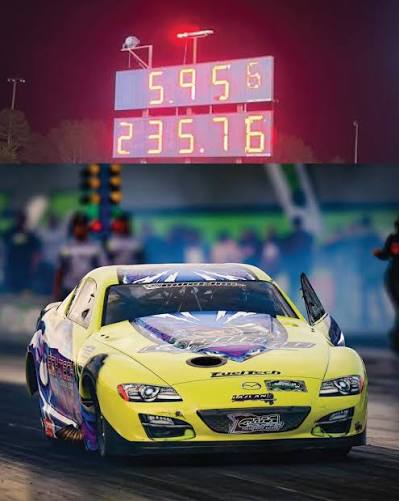
Twelve years later, on December 4, 2025, the scoreboard at Orlando Speed World answered the question for him.
5.956 seconds.
235.76 miles per hour.
Edwin Burgos had become the first driver in history to take a rotary-powered car through the quarter-mile in under six seconds.
But if you begin Edwin Burgos’ story there, you miss almost everything that made the moment matter.
Because Loquito didn’t become a legend in 5.956 seconds.
It took a lifetime.
Before Loquito Killer
Burgos grew up in Bayamón, Puerto Rico, and his relationship with speed began long before purpose-built race cars and world records.
In a long-form interview preserved by XtremeDragPhoto, Burgos recalled racing on the streets as a young man, sliding his father’s 1970 Malibu Super Sport around in the early 1980s and developing the car control that would later follow him to the drag strip.
The person Burgos credits with changing the direction of that life was Berto Vivo.
It was Vivo who gave him the nickname “Loquito.” Burgos would hang around his shop until eventually he became a customer, then an employee. More importantly, Vivo helped move Burgos away from street racing and toward the racetrack, giving him both mechanical foundations and an opportunity to drive a race car responsibly.
Burgos told DragCoverage that he traces his organized racing career back to around 1989. Archival interviews show that by 1992 he had his first race car of his own: a red Toyota Starlet called the Krazy Killer. It was an aspirated, nitrous-assisted combination that ran 10.30s on a 24×8.5-inch tire.
That first Starlet is important because it explains something about Burgos that gets lost when people simply call him a driver.
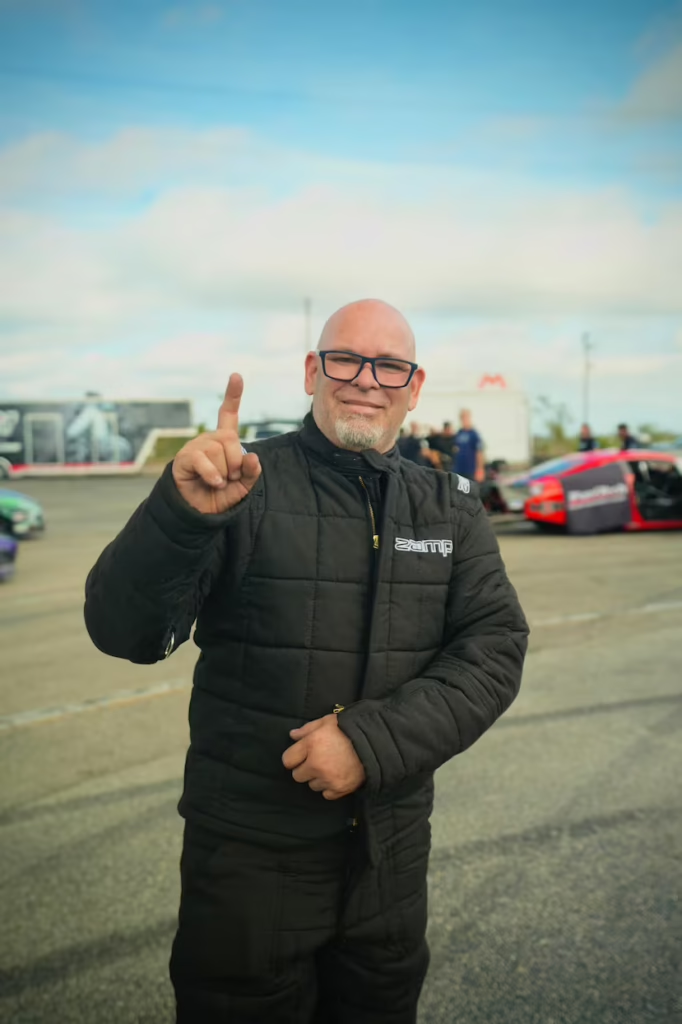
Edwin Burgos builds things.
He learns them. He changes them. He breaks them. He studies why they broke. Then he tries something else.
By 2010, Burgos said he had already been working as a mechanic for 18 years.
Over the years, names like Traviesito, El Bacán, Chuchazo, Kapicu and El Confinado became chapters in that education. There were nitrous combinations, twin turbos, alcohol, unconventional ideas and experiments that sometimes sounded ridiculous until they worked.
Asked years ago whether the “Loquito” nickname fit him, Burgos essentially explained that what other people called crazy, he called experimenting.
That might be the best way to understand his entire career.
He has never been particularly interested in doing something simply because that’s the way everybody else does it.
A 13B, a Starlet and a 6.84 That Changed Things
Long before the RX-8 became synonymous with Loquito Killer, there was La Otra.
In 2010, Burgos drove the 13B-powered Toyota Starlet to a staggering 6.84 at 201 mph at Old Bridge Township Raceway Park in Englishtown, New Jersey.
It was an extraordinary number for a tiny, short-wheelbase, 3/4-chassis Starlet—the kind of car racers affectionately call a “shoebox.”
Burgos wasn’t simply handed the keys. Contemporary accounts credit him with building the rotary engine, while Jorge “Oso Tech” Juarbe handled tuning duties. Years later, Burgos still identified that 6.84 pass as one of the defining accomplishments of his career.
He followed it with a 6.86 in La Briana Zoe.
And gradually, Burgos’ name meant something beyond Puerto Rico.
It meant that when an unconventional rotary combination showed up somewhere and Edwin Loquito Killer Burgos was involved, you probably shouldn’t assume you knew what it was capable of.
His travels eventually took him through tracks across the mainland United States. He remembers racing in New Jersey, including Atco, and making the kind of road trips that helped forge the Puerto Rico-versus-the-world identity that still defines import racing today.
But a Starlet could only take the vision so far.
Edwin wanted something different.
Something capable of chasing the world.
Building Loquito Killer
The RX-8 story began with another Edwin: Mech-Tech’s Edwin Colón.
Burgos recalled Colón watching him race Kapicu at Englishtown. Afterward, Colón approached him about building something more serious.
Burgos knew exactly what he wanted:
A full-chassis RX-8.
Three rotors.
A car capable of chasing records.
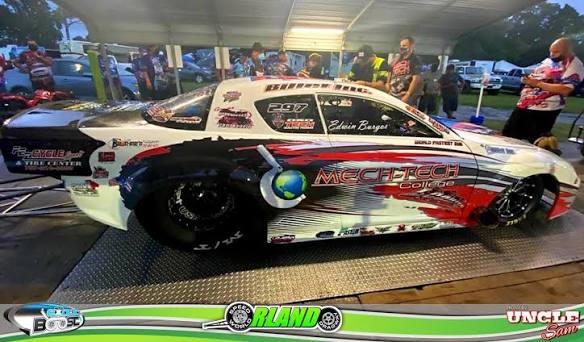
The result became the machine the world knows as Loquito Killer.
The chassis came from Tim McAmis. The carbon-fiber RX-8 body was produced through Mech-Tech. The heart of the car evolved into a semi-peripheral-port billet Mazda 20B, with Burgos himself credited as the engine builder, accompanied by a single Precision turbo and a G-Force transmission in its 2019 record-setting configuration.
That distinction matters.
When Edwin Burgos straps into Loquito Killer, he isn’t disconnected from what is happening a few feet in front of him.
His fingerprints are on the mechanical story.
He understands the engine because he has lived with the engine.
He knows what the combination has endured because he helped create it.
And he is still, at his core, a mechanic.
Burgos even laughs when talking about Tim McAmis, jokingly referring to the legendary chassis builder as “his mechanic.”
As Burgos tells the story, his team was once in the United States and needed somewhere to freshen an engine. They stopped at McAmis’ shop, were allowed to use the facility, and McAmis himself even lent a hand.
It is a funny story when Edwin tells it.
But it also says something about the relationships built over a lifetime in racing.
A chassis builder from Missouri and a rotary racer from Puerto Rico, both standing around a race engine because the race still had to be made.
Puerto Rico Versus Australia
By 2013, Burgos was already thinking much bigger than simply making quick passes.
He was thinking about Australia.
PAC Performance had become a benchmark in world rotary racing, and Burgos made no secret of his desire to chase them. He wanted the three-rotor record back in Puerto Rico.
Then, in 2014, the battle became very real.
PAC Performance moved the rotary speed record to 223 mph.
One week later, Loquito Killer arrived at Maple Grove Raceway in Pennsylvania.
First came 224 mph.
Then 225.
Then Edwin Burgos and the 20B RX-8 blasted to 227.73 mph on a 6.30-second pass.
Three resets of the rotary speed record during the same event.
The record was going back to Puerto Rico.
Three years later, Burgos went directly into the Australians’ backyard.
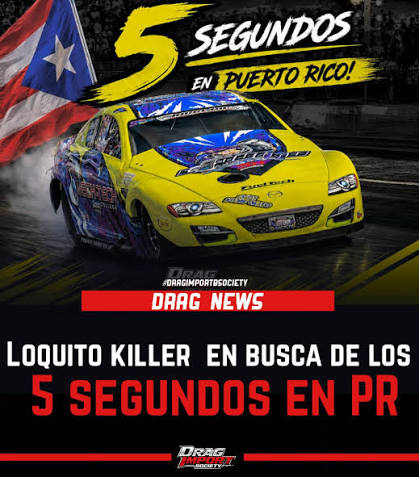
In 2017, Loquito Killer joined a powerhouse Puerto Rican contingent traveling to Brisbane for the Jamboree. Australian media described the visiting RX-8 as one of the world’s iconic rotary cars.
But Australia did not give Burgos the storybook ending.
During testing, the driveshaft failed.
Then came fire.
The damage was significant enough to sideline the car for more than a day.
So they took it apart.
And rebuilt it.
Local Australian businesses came to the aid of the Puerto Rican visitors. The team worked until Loquito Killer was nearly back together by Saturday. Burgos returned Sunday after what Australian coverage described as another complete rebuild, only for more mechanical issues to prevent the car from making the kind of pass everyone had traveled thousands of miles hoping to see.
No record.
No perfect ending.
Just a broken car, a burned car, a group of racers fixing it and Edwin Burgos trying again.
In other words, a very Loquito Killer story.
The Road Warrior
Long before DragCoverage sat down with Edwin, another outlet had already found the right nickname for him.
The Road Warrior.
It fits.
Because the records are only one part of this.
The harder part is everything between them.
The broken engines.
The damaged parts.
The long nights.
The trips from Puerto Rico to the continental United States.
The trip to Australia.
The failures that happen after you’ve spent money, traveled thousands of miles and told everybody what you were trying to accomplish.
And then having enough belief left to load everything back up and try again.
By 2016, the PDRA was describing Burgos’ RX-8 as a quarter-mile world-record holder at 6.19 seconds and 230 mph, with a 4.05 eighth-mile best.
In 2019, Loquito Killer again rewrote the rotary record book, recording a 6.08 at 229 mph and reclaiming the outright rotary mark. An international performance publication didn’t need DragCoverage to decide what Burgos had become by then.
They simply referred to him as “the legend Edwin ‘Loquito Killer’ Burgos.”
The article also noted something far more prophetic: Loquito Killer was still chasing the first five-second rotary pass.
Still chasing.
That is the theme.
Five Seconds
The strangest part about Edwin Burgos finally running a five is that, once you understand his history, it almost feels inevitable.
Not easy.
Not guaranteed.
Inevitable.
Because more than a decade before it happened, he was already describing how the sport would get there.
He talked about leaving factory engine components behind.
He talked about billet pieces capable of surviving stresses racers were only beginning to understand.
He talked about better fuel systems, injection and technology.
He talked about continuing to experiment.
And most importantly, when asked whether five seconds was really possible, he never hedged.
He believed it was.
Year after year, the numbers crept closer.
6.4.
6.3.
6.19.
6.08.
The cars got faster.
The engines got stronger.
The technology caught up with some of the ideas Loquito had been talking about years earlier.
And still the scoreboard refused to show a five.
Until December 4, 2025.
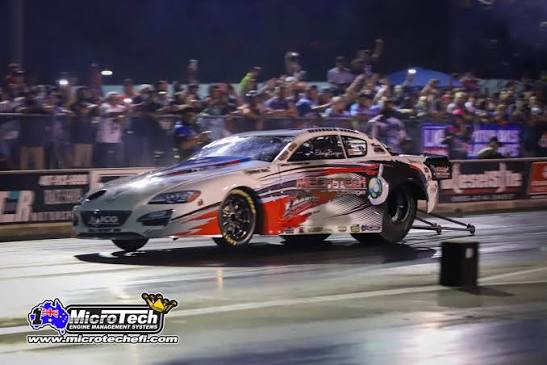
At Orlando Speed World, Burgos staged Loquito Killer one more time.
The 20B screamed through 1,320 feet.
And the board lit:
5.956.
235.76 mph.
The barrier that Edwin Burgos had publicly said could be broken more than a decade earlier was gone.
The first official five-second rotary pass in history belonged to Loquito Killer, Burgos, Mech-Tech and the team that had spent years refusing to let six seconds be the final answer.
And Burgos’ reaction was fitting.
He didn’t make the accomplishment only about himself.
He credited the crew, Mech-Tech and the people who had worked beside him through every bolt, test and failure.
The mantra remained the same:
“Yo no me quito.”
I don’t quit.
Records Are Temporary. First Is Forever.
Racing is cruel about records.
Someone is always coming.
Less than two months after Loquito Killer made history, Joel Olivo’s Grey Bullet RX9, driven by Juan “Juanchy” Illanas, ran 5.935 at Orlando Speed World and took the outright rotary ET record away.
That’s racing.
Records are borrowed.
Sometimes you hold them for years.
Sometimes weeks.
Eventually, somebody gets quicker.
But there is one thing the next racer can never take.
Edwin Burgos was first.
The first rotary into the fives.
Forever.
There will be quicker rotary cars.
There will be faster rotary cars.
There may eventually be numbers that make a 5.956 look ordinary.
But nobody will ever again be the first person to put one in the fives.
That part of the history book is already written.
And He’s Still Not Done
When DragCoverage spoke with Burgos, he didn’t sound like a man interested in turning Loquito Killer into a museum piece.
He was talking about taking weight out of the car.
Finding more.
Going quicker.
Continuing to develop the combination.
Of course he was.
That’s what makes this story work.
Edwin Burgos finally accomplished the dream that had followed him for more than a decade—and almost immediately started thinking about what came next.
Because Loquito has never really been chasing a number.
He’s been chasing the next idea.
The next improvement.
The next thing somebody says can’t be done.
And throughout our conversation, he kept returning to the people around him—the teams, mechanics, sponsors, friends and supporters who have made it possible to continue doing this for so many years.
The old interviews tell the same story.
Whenever Burgos was asked about a major accomplishment, a list of names usually followed.
Family.
Crew.
Engine people.
Chassis people.
Tuners.
Machine shops.
Sponsors.
Students.
Fans.
The people who opened their doors when something broke.
The people who stayed late.
The people who believed in one more attempt.
Maybe that is why his legacy reaches beyond a timeslip.
Legend
The word legend gets thrown around too easily in racing.
Win enough races? Legend.
Drive something fast? Legend.
Stay around long enough? Legend.
But Edwin Burgos has earned the word the difficult way.
He helped push a 13B-powered Toyota Starlet to 6.84 at over 200 mph.
He built engines.
He drove other people’s cars.
He experimented with combinations people thought were crazy.
He chased Australian rotary giants across the record books.
He carried the Puerto Rican flag to tracks around the world.
He watched Loquito Killer catch fire in Australia and helped put it back together.
He held world records.
Lost world records.
Won them back.
He spent more than a decade chasing five seconds after publicly saying five seconds could be done.
And on December 4, 2025, he proved himself right.
The beautiful part is that Edwin told us how to write the ending years before any of us knew what the ending would be.
How did he want to be remembered?
Not as the fastest.
Not as the world-record holder.
Not even necessarily as the first man in the fives.
He wanted people to know that he never quit.
Maybe that’s the difference between a hero and a legend.
Heroes get remembered.
Legends never die.
And somewhere in Puerto Rico, Edwin “Loquito Killer” Burgos is still taking weight off a race car, still working on an engine, still thinking about the next pass and still proving that sometimes the craziest idea in the room just needs the right person who refuses to give up on it.