
As racetracks across the country head to auction, Banks County officials are sending a message to prospective buyers: Large-scale redevelopment faces serious obstacles, but the county is ready to help bring racing back.
The drag racing community has experienced a roller coaster of emotions over the past week.
After an aggressive acquisition campaign that saw IHRA and its associated ownership group purchase racetracks across the country, the announcement that 12 racing properties were headed to auction left racers wondering what would happen next.

With sealed bids due November 17, speculation has been running wild.
Some believe the properties were purchased with the intention of eventually converting them into data centers. Others fear historic racing facilities will be bulldozed to make way for subdivisions, warehouses, or commercial developments.
And while those concerns are understandable, there’s an important part of the conversation that seems to be getting overlooked.

Just because someone purchases a piece of property doesn’t mean they can do whatever they want with it.
DragCoverage recently spoke with Banks County Commission Chairman Taylor Griffith about the future of Atlanta Dragway in Commerce, Georgia. The conversation offered some much-needed perspective on the realities of redevelopment and, perhaps more importantly, some legitimate reasons for optimism.
You Can’t Build What You Can’t Support
On paper, Atlanta Dragway looks like an attractive redevelopment opportunity.
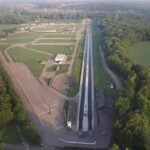
The property encompasses approximately 343 acres near Interstate 85, surrounded by a growing commercial corridor. It’s easy to understand why someone might look at that much land and envision a major residential development, industrial project, or even a data center.
But there’s a problem.
Water.
According to Griffith, Banks County’s water supply is already approaching its permitted capacity, creating an enormous obstacle for projects requiring substantial additional water.
The county’s reservoir-based water system has a withdrawal limit of approximately one million gallons per day. Griffith explained that the vast majority of that supply is already being utilized. (over 90%)
And that limit isn’t simply a number local politicians can decide to change.
Water withdrawals are regulated through the Georgia Environmental Protection Division (EPD), with permits based on factors such as reservoir capacity, available water, and downstream flow requirements.
In other words, even if Banks County officials wanted to accommodate a massive new development, they cannot simply authorize hundreds of thousands of additional gallons of water consumption.
The available supply has to exist, and the necessary state permits have to support it.
Griffith explained that expanding the county’s water supply through another reservoir would be an extraordinarily expensive undertaking, potentially requiring decades of planning, permitting, and construction.
That presents a significant problem for anyone considering purchasing Atlanta Dragway with plans for a water-intensive development.
Could a developer explore alternative water sources, specialized cooling systems, or substantial infrastructure investments? Potentially. Not every data center uses the same amount of water.
But Griffith’s position was clear: Banks County does not currently have the water capacity to support the type of major redevelopment that some people are envisioning.
And that isn’t just an opinion from a county official. Georgia’s own water-planning documents confirm the county’s limited permitted reservoir withdrawals and identify long-term water supply challenges.
This Has Already Been Put to the Test
This isn’t the first time someone has envisioned a future for Atlanta Dragway that didn’t involve racing.
In 2025, Banks County considered a proposed development that would have transformed the former racetrack property into a massive mixed-use residential and commercial project.
The proposal included approximately 1,193 residential units and 336,000 square feet of commercial space.
According to Griffith, the development projected a water demand of approximately 480,000 gallons per day.
For a county with a reservoir system already approaching its permitted capacity, that represented an enormous problem.
The Banks County Commission ultimately denied the rezoning request in February 2025, with water and sewer availability among the major infrastructure concerns raised during the process.
This history matters because it demonstrates that these challenges aren’t hypothetical.
A developer has already attempted to pursue large-scale residential development at Atlanta Dragway, and that proposal did not receive the necessary approval.
Now, as the property approaches another potential change in ownership, Griffith wants prospective buyers to understand those limitations before investing millions of dollars.
The concern is straightforward: Someone could purchase the property expecting to build a large residential project or water-intensive data center, only to discover that the necessary infrastructure and approvals aren’t available.
That creates the potential for expensive disputes and litigation involving the county.
Griffith would much rather prospective buyers understand the limitations before submitting bids than purchase the property with expectations that cannot realistically be met.
A winning bid buys the property. It doesn’t guarantee approval for whatever the buyer wants to build.
Banks County Wants Its Racetrack Back
Perhaps the most encouraging part of our conversation had nothing to do with water.
It was the county’s willingness to help bring Atlanta Dragway back to life.
Griffith made it clear that Banks County is interested in working directly with anyone who wants to purchase the facility and restore racing operations.
In fact, the county has already taken steps toward that goal.
Earlier this year, Banks County commissioners unanimously approved a conditional-use request allowing the property to return to racing operations.
That decision, combined with Griffith’s latest comments, sends a pretty encouraging message.
The county isn’t looking for reasons to keep Atlanta Dragway closed.
It’s looking for ways to help it reopen.
Griffith specifically discussed the possibility of working with new ownership through economic development programs, potential tax abatements, low-interest redevelopment financing, and other resources available through local government and development authorities.
Those opportunities would naturally depend on the specific project and applicable approvals, but the willingness to explore them is significant.
And the county is also realistic about something racers understand all too well.
Racetracks are expensive to purchase, maintain, and operate.
A buyer who acquires hundreds of acres along a growing commercial corridor may need additional revenue streams to make the investment financially sustainable.
Banks County understands that.
It Doesn’t Have to Be Racing or Development. It Can Be Both.
One of the most interesting points Griffith raised was the possibility of combining a functioning racetrack with smaller commercial developments on portions of the property that aren’t essential to racing operations.
After all, Atlanta Dragway doesn’t need every acre of the property dedicated exclusively to the dragstrip.
There’s road frontage and unused acreage that could potentially support complementary businesses.
Griffith mentioned possibilities including restaurants, small retail businesses, storage facilities, campgrounds, and even entertainment venues.
Imagine a reopened Atlanta Dragway surrounded by businesses that help support the facility financially.
A restaurant near the entrance. A campground for racers and spectators. Additional retail or commercial activity along the road frontage.
Those businesses could generate additional revenue for the property owner while helping create a destination that extends beyond the racetrack itself.
And rather than replacing the facility, those businesses could benefit from the thousands of racers, spectators, and families who travel to events throughout the year.
Of course, any commercial projects would still need to satisfy zoning, infrastructure, and other applicable requirements.
But the important distinction is that Banks County is willing to consider a practical, financially sustainable approach to preserving racing rather than insisting that the entire property remain untouched.
That kind of flexibility could make a meaningful difference for someone trying to justify a multimillion-dollar investment.
It’s also worth remembering that racetracks contribute more than property tax revenue.
Race weekends bring customers to hotels, restaurants, gas stations, retail stores, and countless other businesses.
For a county located along Interstate 85, having a destination that attracts visitors from throughout the Southeast represents an economic opportunity of its own.
What About the Other Racetracks?
Naturally, the conversation raises another question.
Could similar circumstances exist in the counties surrounding the other racetracks currently headed to auction?
We certainly hope so.
Atlanta Dragway is just one property, and its circumstances cannot automatically be applied to facilities in Ohio, Michigan, North Carolina, Tennessee, Virginia, Kansas, or New York.
Different properties have different zoning classifications, utility infrastructure, development potential, and local governments.
Some could be attractive redevelopment targets. Others may face infrastructure limitations that make continued racing a more practical use of the property.
That’s why understanding the local circumstances surrounding each facility is so important.
A few hundred acres of land might look incredibly valuable to a residential developer or technology company.
But the property’s actual redevelopment potential depends on considerably more than its acreage and location.
And if local governments recognize the economic and cultural value of their racetracks, there may be opportunities for partnerships that help preserve those facilities while still allowing investors to make financially responsible decisions.
A Reason for Hope
Nobody can guarantee what happens to Atlanta Dragway when the bidding process concludes.
The property will ultimately go to a buyer, and that buyer will have to determine whether the economics of reopening and operating a racetrack make sense.
But after speaking with Banks County leadership, there’s reason to believe the situation may be considerably more encouraging than some of the speculation circulating throughout the racing community would suggest.
The county has serious water supply limitations that complicate major redevelopment.
It has already rejected a large residential proposal.
It has taken formal action to allow racing to return.
And its leadership has expressed a willingness to work with a future owner on economic development opportunities and reasonable commercial uses that could help make the property financially sustainable.
That’s a substantially different picture from the idea that the facility is inevitably destined to become a data center or subdivision.
The racing community has every reason to remain concerned about the future of these historic properties. Losing even one more racetrack would be devastating to the people and communities who depend on it.
But there’s also a difference between being concerned and assuming the worst.
Atlanta Dragway has something working in its favor that money alone cannot buy: a local government that wants racing to return and is willing to help make it happen.
Hopefully, as the future of the other racing facilities becomes clearer, we’ll discover that Atlanta Dragway isn’t the exception.
Maybe other counties recognize the same thing.
And maybe, just maybe, the next chapter of this story isn’t about losing racetracks.
Maybe it’s about finding the right people to bring them back.
— Kline Whitley